
Share:
Share:
When it comes to networking advice, students and early-career professionals are often told to “reach out to people who inspire you and ask for a quick coffee chat.” But while the idea sounds easy, reality can feel intimidating. How do you approach an industry expert? What do you even ask? And with busy professionals juggling packed schedules, getting a response can be hit-or-miss.
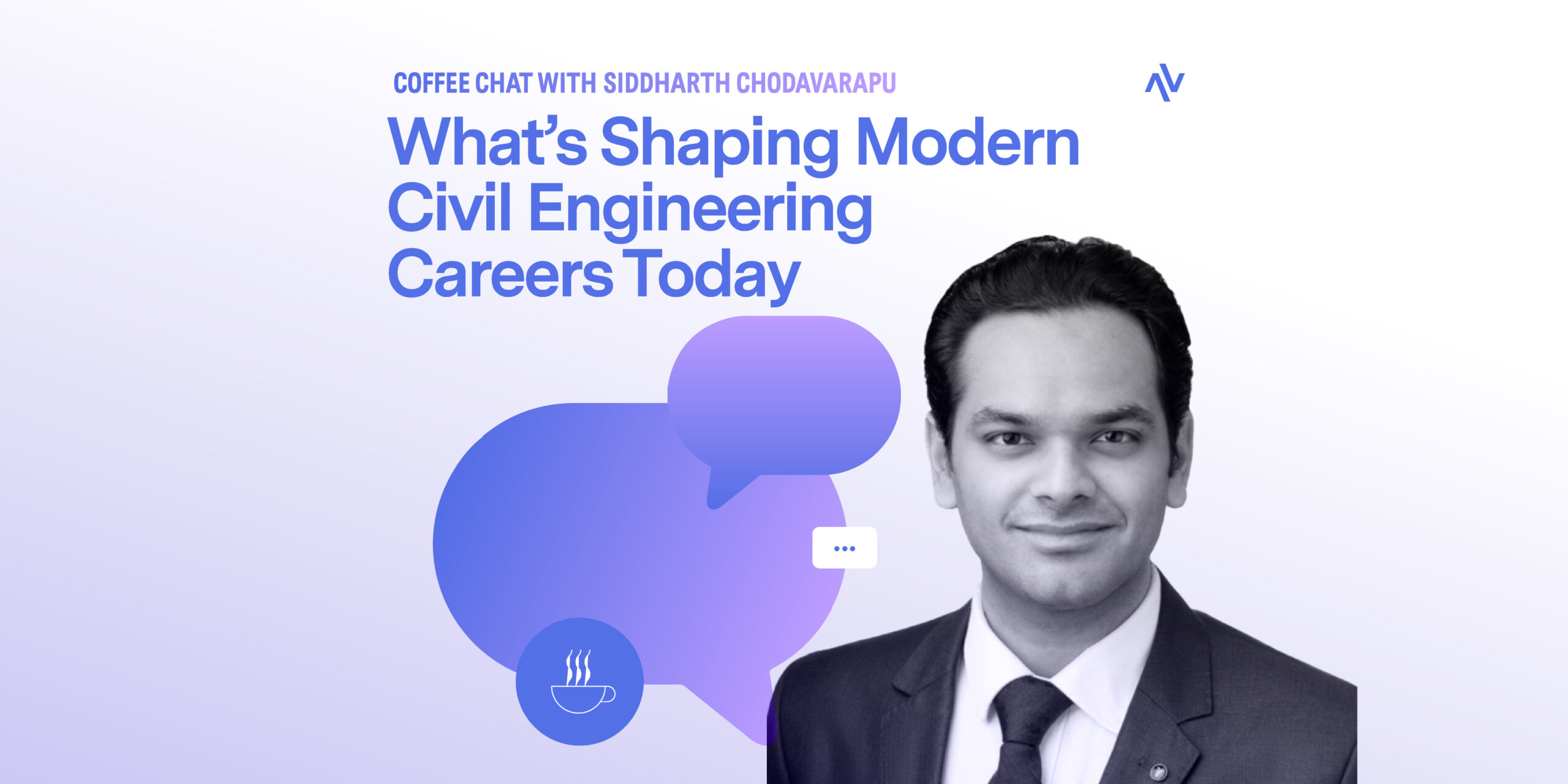
That’s why Open Avenues is here to bridge that gap and bring expert guidance directly to you. Welcome to this edition of our Coffee Chat Series, featuring Civil Engineering Fellow Siddharth Chodavarapu.
He is a Construction Claims Consultant based out of Philadelphia, performing forensic analyses of construction delays, disruptions and cost overruns to assist clients with construction litigation and dispute resolution needs. He also provides project controls, schedule and cost management services for active construction projects.
For Siddharth, civil engineering has always been more than blueprints and structures. It’s about shaping how people live, move and connect with the world around them. His career journey spans urban planning challenges, large-scale construction management, and his current work as a construction claims consultant. Through each step, he has seen firsthand the complexity and purpose that defines the field.
In this Coffee Chat, Siddharth shares how the civil engineering industry is evolving, what skills students should be developing now, and why adaptability, curiosity, and hands-on experience remain the most valuable assets for anyone aspiring to build the future.
A: I got into civil engineering because I was always interested in how things are built and how infrastructure shapes the way people live, how businesses thrive or don’t, and how it affects general quality of life and livability. Seeing and experiencing urban planning challenges in India certainly kindled the flame. I liked the mix of creativity and logic that comes with solving real-world problems through design and construction. Actually, studying structural design, geotechnical engineering and water resources engineering revealed to me how much coordination and planning go into even the simplest-looking projects. I interned at different construction and structural design firms and settled on construction project management as a field of concentration for grad school.
I got my master’s in construction project management, where I really started to see the bigger picture, such as how technical decisions, contracts, and people all connect in project delivery. That perspective stuck with me.
I also spent about a year and a half working in field construction in India before grad school on various mechanical construction and warehouse projects, which was eye-opening in terms of the day-to-day realities of managing teams, handling constraints, and making things work on project sites. Small coordination issues or unclear communication can snowball into major delays. I learned to respect how every role on a project, from engineers to foremen and laborers, contributes to the outcome.
Now I work as a construction claims consultant, where I look at projects from both a technical and contractual angle. It’s a different side of the industry, but it builds on everything I learned in the field; understanding what actually happens on an everyday basis on projects helps me assess issues more practically and fairly. That has given me a lot of perspective on how I think about project management and how identifying risks early, keeping records organized, and maintaining clear communication prevents issues from escalating into large claims or delays.
A: One of the trends that excites me most right now is how technology is changing construction. Tools like BIM (Building Information Modeling), AI-assisted scheduling, and data analytics make projects more predictable and transparent. From a claims and project management perspective, this kind of integration has real potential to reduce disputes and improve how teams make decisions in real time. I was lucky enough to have studied BIM in grad school, and to have been exposed to a lot of the cutting-edge research that CII (the Construction Industry Institute) at UT Austin was involved in at the time.
Sustainability is another area that is driving significant meaningful change. There’s more focus now on minimizing waste, lowering carbon impact, and extending the life of infrastructure (for instance with concrete technology and modular construction). I think future engineers will need to combine traditional technical skills with a solid understanding of sustainability and digital tools.
A: For students, I would say start by being curious about how all the pieces of a project connect, from design and contracts to execution and technology. Get comfortable with data, learn how to communicate clearly, and try to get some hands-on exposure through internships or site work. Field experience is worth its weight in gold. The people who can think technically and practically at the same time are the ones who will really stand out. Also, become adept in standard construction industry technology and tools (if you’re interested in construction work) for estimation, scheduling, change order and project management, etc. Expertise in software tools makes a very compelling candidate for firms and recruiters.
If you want to get your feet wet with BIM or sustainability tools, just start small and hands-on. Download student versions of software like Revit, Navisworks, or even Synchro if you’re curious about 4D scheduling, and experiment with the software instead of (or in addition to) tutorials. Platforms like Autodesk Learning, Coursera, and even YouTube can take you from zero to functional surprisingly fast. For sustainability, look into resources such as the LEED Green Associate material. Honestly, the best way to learn is to pick a tiny project (such as a building, a footbridge, anything) and try modeling or analyzing it yourself. You’ll learn more by doing one imperfect project than you would by doing several online courses.
A: Honestly, I didn’t decide on a specialization early. I figured it out by doing a bunch of things and paying attention to what actually clicked. In undergrad, I enjoyed structural, Geotech, and water resources, but none of it fully made sense to me until I saw it in the real world. Internships were where it really started coming together, design was interesting, but being on construction sites was what stuck with me. I liked the energy, the problem-solving, the coordination chaos, the pace… even the imperfections.
What pushed me toward construction and project delivery wasn’t a single moment, but it was realizing I enjoyed the people + problem + execution side of engineering more than sitting in one technical silo. I liked seeing how decisions play out in real time, how teams deal with constraints, and honestly, how messy the process can be even though the end result looks simple from the outside.
For students still figuring it out, my biggest advice is:
A: Looking back at my own path, the biggest thing I’ve learned is that technical knowledge alone is not enough. Civil engineering is changing quickly, with new tools, sustainability goals, and data-driven decision-making becoming part of everyday work. Students who can adapt, stay curious, and understand how different parts of a project connect will have a real edge.
I would tell students to get hands-on experience early, whether through internships, site visits, or even small project simulations. Seeing how projects are built teaches lessons no classroom can. It is also important to build communication skills and learn how to explain technical ideas clearly. The best engineers I have met are the ones who can bridge the gap between design, fieldwork, and management.
Technical skills are also very important – knowing your way around Primavera P6 or Microsoft Project as a scheduler, for instance, can make them stand out in a large pool of applicants. Despite large numbers of applicants, however, the industry is hungry for new talent and is always looking for people, which is very encouraging.
Finally, keep an open mind about where your career can go. The field is broad, from design to construction to claims and project management, and every experience adds a layer to how you think and solve problems. If you stay curious and keep learning, you will stand out naturally.
For me, continuous learning is mostly reactionary to real work. There are several professional associations in civil and cost engineering – the ASCE, AACEI and so many others. Joining professional associations can really help improve your skills and also introduce you to people in the industry that can help you grow your career, meet new people and generally access new opportunities.
Final Thoughts
Our conversation with Siddharth highlights something essential about civil engineering: it is a field built as much on people, curiosity, and adaptability as it is on calculations and design. He emphasized the importance of hands-on learning and clear communication and shared practical advice for students who are still discovering their path, encouraging them to explore different areas, pay attention to what energizes them, and build both technical and real-world skills to stand out in a competitive market.
Siddharth leaves us with a reminder that resonates far beyond civil engineering: the strongest careers are built by staying curious, embracing new tools, paying attention to what motivates you, and learning continuously from both successes and challenges. There is no single “right path”—just the one you build through experience, reflection, and a willingness to keep exploring.

Danila Blanco Travnicek is the Director of Program Strategy & Evaluation at The Build Fellowship where she leads the education programming and its initiatives. She is a social entrepreneur who has been working tirelessly for over 10 years in the nonprofit sector to ensure more people have access to quality education. Danila holds a B.A in Business Management and a master's degree in Teaching and Nonprofit Management. She is a Professor at the University of Buenos Aires, an international speaker and facilitator and has managed and led programs with social impact in Latin America, U.S., Europe and Asia. She also received scholarships to study abroad in Finland, China and the United States.

Mazvita Maboreke is a Human Resources Analyst at Open Avenues Foundation. In her role, she leads initiatives that foster team development, professional growth, and a positive organizational culture. She focuses on designing and implementing programs around training, onboarding, team-building, and employee recognition—helping to cultivate a workplace that is both supportive and high-performing.


Stay updated on all things Open Avenues!
