
Share:
Share:
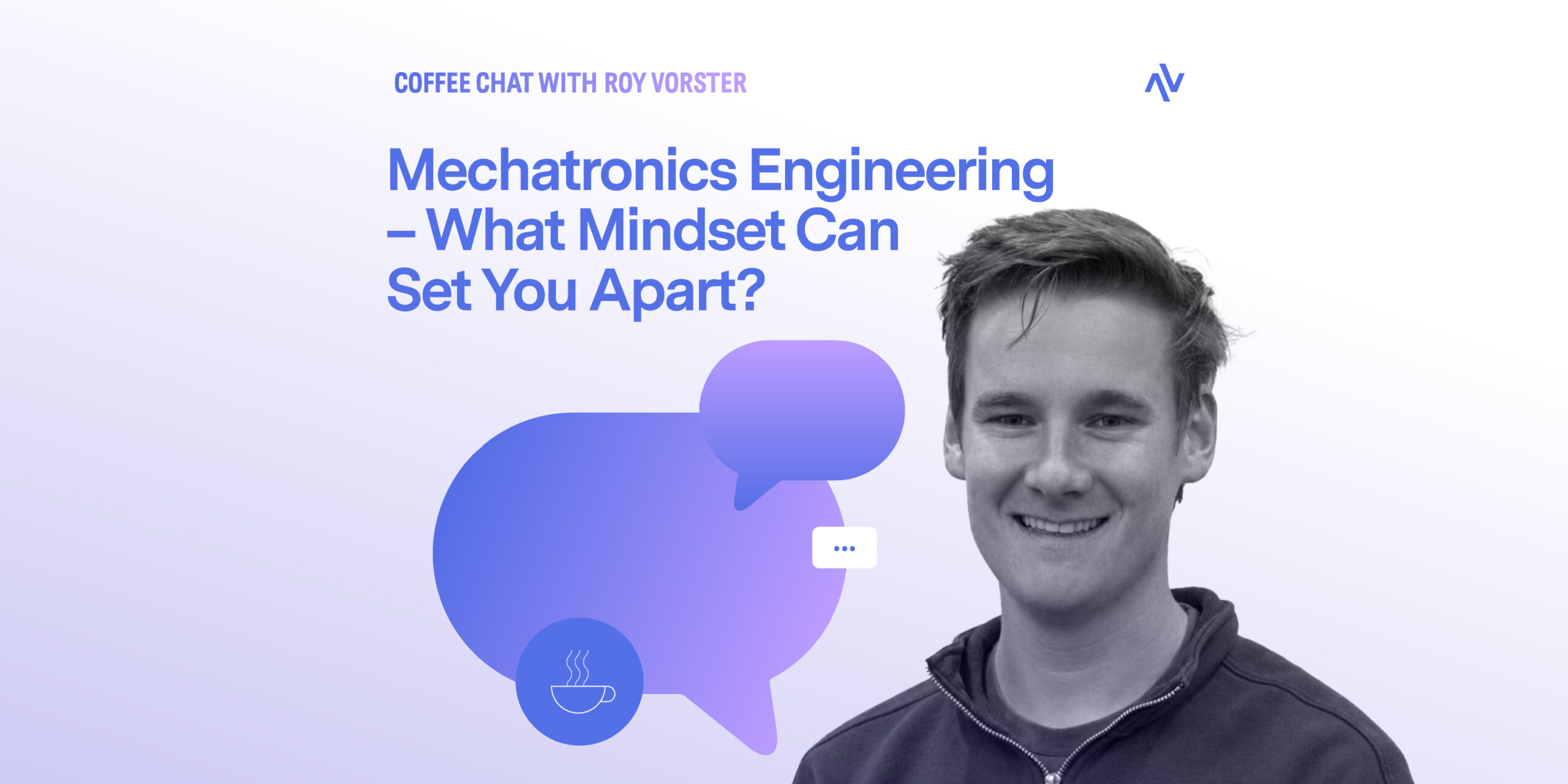
Engineering often looks like perfection from the outside, but in practice it is shaped by experimentation, uncertainty, and constant refinement. In this Coffee Chat, we speak with Roy Vorster, a Mechatronics Engineering Build Fellow at Open Avenues and an autonomy engineer at Skydio, where he works on planning and control for autonomous flight systems.
With experience spanning drone autonomy, control systems, and high-performance engineering — including previous work with the Mercedes Formula 1 team — Roy brings a perspective grounded in both theory and application. Across his work, a consistent theme emerges: strong engineering is not just about solving problems, but about understanding them deeply enough to know why a solution works.
In this conversation, Roy reflects on the role of intuition in engineering, the value of first-principles thinking, and why students grow most when they start building, testing, and learning before they feel fully ready. For Roy, what makes a great engineer isn’t just technical mastery. It’s intuition, relentless learning, a willingness to fail, and the discipline to understand not just how a system works, but why.
A: My interest in engineering really began at home. My dad wasn’t an engineer by trade, but he loved motorcycles, cars, and racing. On the other side of the family, my grandfather was a construction worker, and he taught us woodworking when we were kids. No one in my family pushed me to study engineering, but being around people who loved building and improving things planted the seed. I couldn’t imagine myself doing anything else.
I eventually ended up studying aerospace engineering. Along the way, I worked in student teams, did internships, and started more personal projects than I could count (few of which I actually finished…). Those experiences shaped how I lead and make engineering decisions today. The biggest impact is that I learned early on that engineering is fundamentally about solving problems within constraints: number one being physics, but also time, resources, tools, etc… Doing many different things and seeing them fail taught me that getting things right on the first try is often not an option. It taught me not to chase the perfect solution immediately, but to prioritize learning and iteration.
A: As with many professions, when you’re an engineer you never stop learning things. Everyone will end up working on different things and develop their own unique skills. It is hard to give any specific advice here because I don’t think it really exists. It’s very easy to learn things that interest you, so my recommendation is to find anything in the robotics field that you find fascinating and dig in.
What I do think is valuable for everyone in the engineering field right now is to use AI tools to your advantage. Which I’m aware everyone’s probably heard before! But in my short career this has been the biggest change by far. I use LLM’s every single day to research new things, it’s great at finding and summarizing sources that would have otherwise taken me a lot longer to find. It’s also obviously great as a coding assistant. It’s like having a tireless intern with perfect recall.
A: Intuition is incredibly important in engineering. Good intuition lets you quickly rule out impossible explanations, spot patterns, and iterate faster. It’s what helps you figure out where to look the moment you see a problem before you can fully articulate why.
Intuition comes from a solid theoretical foundation and good practical experience. It’s being able to reason about physics and math quickly (e.g. understanding how things scale relative to one another). But it also comes with time and hands-on experience. Every time you design, build or tune something you’re training this muscle and it’s what separates good engineers from great ones.
A: One of the most valuable mindsets in engineering is learning to think from first principles. When you reason from fundamentals, you are not limited by past solutions. You begin by asking what you know to be true, from physics, mathematics, or the requirements you set, and build your understanding from there. This helps you identify hidden assumptions and make design choices that are grounded in reality rather than habit.
The best way to build this habit is to question everything; be skeptical and constantly test your assumptions. Are you doing something because it’s the right thing to do or just because you’ve seen it done like that before? Are you signing of on an experiment or validation exercise because you truly understand the results, or do the numbers just look nice?
The other mindset that I think is incredibly important is to stay curious. Explore topics adjacent (or unrelated) to your field. You’ll learn things, recognize patterns across disciplines, and often find unexpected ideas that help you solve problems differently. Some of the most valuable engineering insights come from connecting concepts that initially seem unrelated.
A: My biggest advice is to never do things you don’t understand. Copy-pasting code or putting numbers in equations because someone told you to do so is a waste of time. I often catch myself doing something ‘just because’, taking a step back and understanding why will make you a 100X better engineer.
When working with students, I try to make sure they understand why things are true or why you’d do something in a certain way. In my Build Project, I teach students how to write a feedback controller for a quadrotor drone. Of course, I’d like them to learn about quadrotors and their interesting dynamics. But most of all I want them to come away with a general understanding of how to analyze a dynamic system and how to write a feedback controller, such that they can apply these ideas much more broadly.
A: There are two things I think about often.
The first is that very often when you encounter a hard problem, you have to just go at it and start. Whatever you first come up with is very likely not what you’ll end up with as the final solution. And you can either get stuck trying to come up with the perfect solution in one go (you won’t), or you can get pen to paper and start iterating. Learn what you can from your first prototype, but don’t be afraid to scrap it and start over. Iteration exposes the real hidden complexities much faster than weeks of pondering ever will.
The second is that simple systems are better. If you find yourself stuck with a very complicated solution that becomes hard to iterate on and maintain, it’s worth taking a step back and asking yourself whether there’s a simpler solution that is better. There probably is.
An example that comes to mind is from my time working on a torque-vectoring controller for our student electric race car. Our first design was an optimization-based control system that computed the ideal torque distribution across the wheels in real time. It looked great on paper and in simulation. In practice we had a lot of trouble tuning it just right. It only barely ran on the available hardware, not very robust and hard to reason about. We ended up with a much simpler feedback controller with some simple, smart heuristics. That is not to say optimization-based control is too complex (jn fact, very often it is the simple solution!), but in this case it wasn’t, and we had to force ourselves to take a step back.
A: I hope the biggest takeaway for readers of this coffee chat post is that engineering does often come with failures. It’s not always fun, but it’s important! Obviously, you shouldn’t take it lightly when you hit a roadblock, but the key is to learn from them. Whether that’s hitting a roadblock in your existing design, missing targets on key requirements or a test failure.
Although I’m avoiding specifics, an example from my own career was when we had a crash with an early prototype of a new product at Skydio. This was a new type of design for us and we made an early bet that we could control the system with a certain type of controller. During very early flight testing we crashed a vehicle. I had been lax with adding logging information and it was incredibly hard to figure out what happened. In the end we managed to piece together what happened (hint: simulation and the real world are not the same!) and fixed the issue. But this was a valuable lesson in that 1) failures happen and 2) you should be prepared to learn what you can and iterate.
Final Thoughts
Roy’s perspective offers a clear reminder that engineering excellence is shaped as much by mindset as by technical ability. Throughout this conversation, he returns to a few essential ideas: think from first principles, build intuition through experience, simplify wherever possible, and treat failure as part of the learning process rather than a sign to stop.
For students exploring mechatronics, robotics, or control systems, that message is especially relevant: progress rarely begins with perfect certainty. It begins with curiosity, action, and the willingness to keep learning through complexity. In a field moving as quickly as engineering and AI, the people who stand out will not simply be those who know the most, but those who are willing to question assumptions, keep building, and understand deeply why their solutions work.

Danila Blanco Travnicek is the Director of Program Strategy & Evaluation at The Build Fellowship where she leads the education programming and its initiatives. She is a social entrepreneur who has been working tirelessly for over 10 years in the nonprofit sector to ensure more people have access to quality education. Danila holds a B.A in Business Management and a master's degree in Teaching and Nonprofit Management. She is a Professor at the University of Buenos Aires, an international speaker and facilitator and has managed and led programs with social impact in Latin America, U.S., Europe and Asia. She also received scholarships to study abroad in Finland, China and the United States.

Rik Abels is a Finance Build Fellow at Open Avenues Foundation, where he works with students leading projects in investment analysis and entrepreneurship. Rik is a Principal at Clew Partners, where he focuses on advising buy-side clients on M&A transactions, sourcing and facilitating acquisitions for strategic investors across a number of different industries.
Rik has over three years of experience in the finance field. With a background in technology venture capital, government, and public policy, he has spent the past years advising clients on acquisitions in sectors such as IT services, pharma services, and residential and commercial home services. Rik holds a Bachelor of Arts in Economics and Government from Dartmouth College.


Stay updated on all things Open Avenues!
