
Share:
Share:
Choosing a career in engineering often starts with a clear picture of what the job might look like, but in reality, that picture evolves quickly once you step into the field.
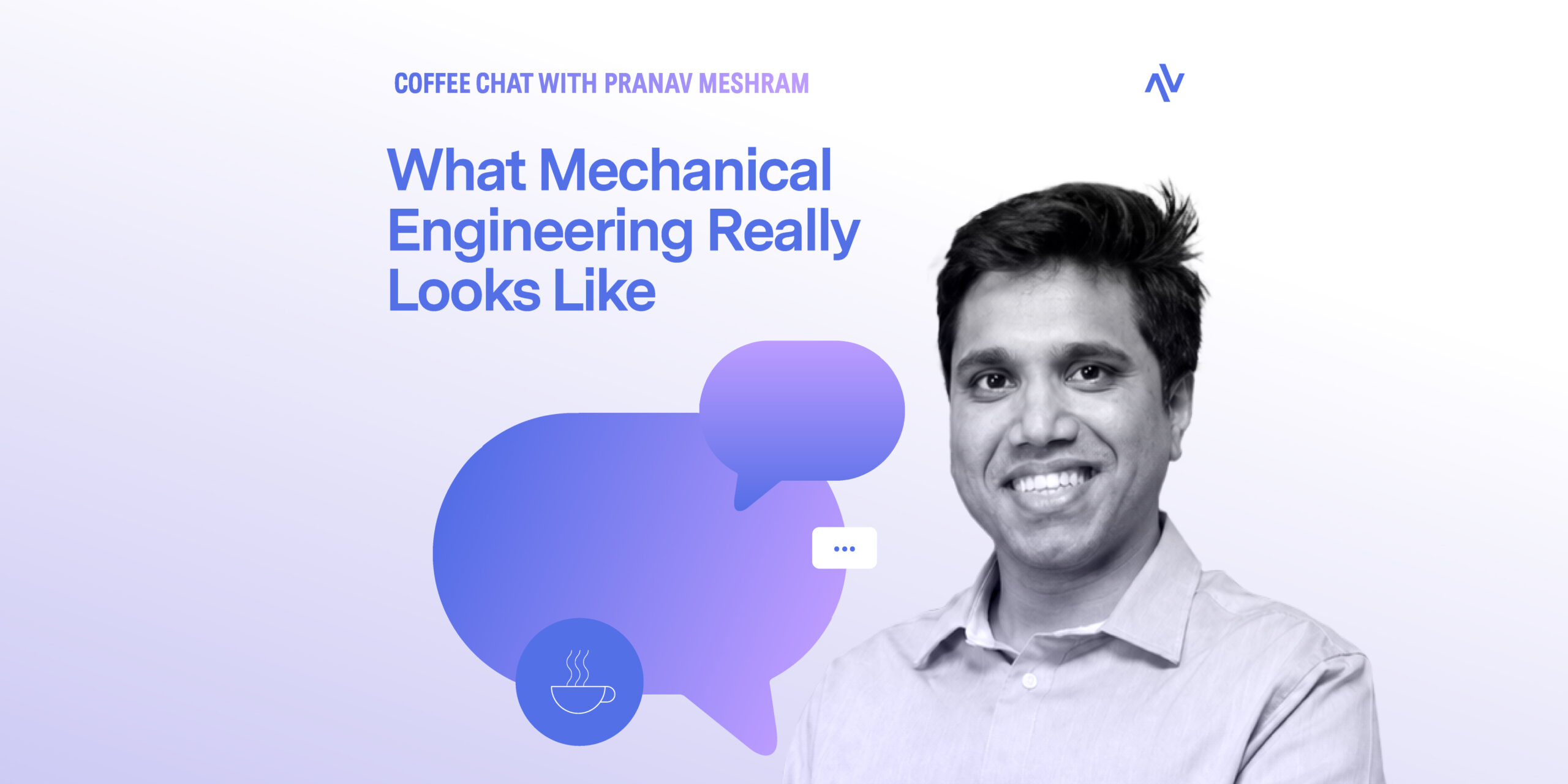
In this Coffee Chat, Pranav Meshram shares his journey from studying mechanical engineering to working on real-world automotive programs, collaborating with global OEMs, and managing the full lifecycle from design to production.
Through his experiences, you will gain a practical understanding of what mechanical engineering looks like beyond the classroom, the skills that truly matter in industry, and how to navigate the transition into a professional engineering role.
A: Honestly? I thought I’d be the person at a desk doing pure design work modeling parts in SolidWorks all day, optimizing geometry, maybe running simulations to test how parts behave under stress. Clean, technical, and contained. I had this image of an engineer as someone who hands off a drawing and the world just… builds it.
What I do at Vistech is both more chaotic and more rewarding than that picture. Yes, I use SolidWorks, CATIA, and ANSYS regularly. But I also sit in rooms with Honda and Toyota engineers negotiating timelines, writing engineering reports for clients, and troubleshooting production issues on the floor. My role as a Program Engineer means I’m the connective tissue between concept, tooling, and mass production for interior soft trim components on vehicles like the Honda Accord, CR-V, Toyota Sequoia, and now new EV platforms.
So, am I ‘close’ to what I imagined? The technical core is there. But the communication layer, the cross-functional coordination, the program management mindset that part I did not see coming. And it’s the part I find most fulfilling.
A: For me, the signal came from a capstone project during my Master’s at the University of Maryland. We were tasked with redesigning the DeWalt DCS570B cordless circular saw, analyzing every component for performance, cost, and manufacturability. That project clicked something for me: I loved the intersection of design intent and production reality. Not just ‘can we make this part better’ but ‘can we make it better in a way that actually scales?’
That led me naturally toward automotive manufacturing, an industry where tolerances matter; volumes are high, and the cost of a bad design decision can ripple across hundreds of thousands of vehicles. If you’re still unsure, here are three signals I’d suggest paying attention to:
A: The skills that have paid off most aren’t necessarily the most glamorous. Let me be specific:
GD&T (Geometric Dimensioning & Tolerancing): This is the standardized language engineers use to communicate exactly how precise a part needs to be. If you can’t read and apply it correctly, suppliers build parts that don’t fit, and you only find out when they’re already on the production line. I saw this firsthand when reviewing early supplier drawings at Vistech.
DFMEA and PFMEA (Failure Mode & Effects Analysis): These are structured tools for thinking through everything that could go wrong with a design or a manufacturing process, before it goes wrong. It sounds like busywork. It isn’t. I’ve seen FMEA catch critical issues that would have caused a product recall. In the Build Fellowship projects I mentor, I have students build detailed DFMEA and PFMEA documents because that discipline is non-negotiable in industry.
CAD fluency across platforms: CAD software is how engineers communicate designs. I use SolidWorks and CATIA depending on which OEM I’m working with, and Fusion 360 for faster prototyping. Being able to move between tools confidently is a practical advantage.
What I wish I had built earlier? Statistical thinking. In manufacturing, every process has variation, and if you can’t measure and interpret it, you can’t control quality. Tools like Minitab and concepts like process capability and control charts were things I had to learn on the job. A course in applied statistics or Six Sigma fundamentals before you graduate will give you a real head start.
A: The handoff moments.
Students are often taught to think in neat phases: design, then prototype, then test, then manufacture. But in practice those phases bleed into each other constantly, and the friction lives in the transitions.
Here’s a concrete example: I’ve seen beautifully engineered CAD models that were essentially unbuildable at volume because no one flagged a tooling constraint during design review. The part looked perfect on the screen. Then we’d sit with the tooling engineers and realize the draft angle was wrong, or the material couldn’t flow into that geometry consistently at the production speeds we needed.
Students also underestimate the role of packaging and material handling. How a part gets from one station to the next, how it’s stored, how it arrives to the production line, all of this directly affects scrap rates and quality. I developed internal standards for Part Presentation, Material Handling Devices, and Packaging at Vistech for exactly this reason. We reduced scrap generation by 13% not because of a design breakthrough, but because we got more disciplined about process standardization.
The key takeaway for me is that great engineering doesn’t stop at the design stage. The transitions between phases are where real-world projects succeed or fall apart.
A: It is no longer optional. Full stop.
When I sit across from a Honda or Toyota procurement engineer, they’re not just evaluating my technical answer. They’re evaluating whether they can trust me to represent the project accurately. If I can’t explain a tooling cost estimate clearly, or if I stumble through a design review without connecting technical decisions to business impact, I lose credibility and so does my company.
Over five years, I’ve worked with OEMs including Nissan, Acura, Tesla, Rivian, GE, and 3M. Each has a different culture, different documentation expectations, and different levels of technical depth in their meetings. Reading the room and adapting your communication accordingly is a skill in its own.
I can think of these 3 recommendations to improve this skill:
The engineers who move up fastest are the ones who can translate between the design floor and the boardroom.
A: Speed and ambiguity. At university, a project has a defined problem statement, a rubric, a deadline. In my first months at Vistech, I’d get an email that was essentially: ‘We need a tooling cost estimate for a new trim component OEM review is in three days.’ The information was incomplete, the stakeholders were hard to reach, and the stakes were real.
I came from a strong academic background a Master’s from the University of Maryland, a graduate certificate in Semiconductor Packaging, a Bachelor’s from NIT Jamshedpur. That foundation helped. But knowing how to apply ANSYS in a structured lab setting is very different from knowing which analysis to prioritize when you have 72 hours.
How did I close the gap?
The real lesson: in professional engineering, you will rarely have all the information you need. Learning to make sound decisions with incomplete data, under time pressure, is one of the most important skills you can develop.
A: The students who grow fastest aren’t always the ones who know the most. They’re the ones who treat a consumer product disassembly like a puzzle rather than a task. They don’t just complete the deliverable. They ask: ‘Why did the manufacturer make this design decision? What were they optimizing for? Could it be done differently?’
In the Build Project I mentor, Reconstruction of Consumer Products Using Engineering Design Principles, students take a real consumer appliance, reverse-engineer it, and redesign it for mass production, reliability, and safety. The tools they use, DFMEA, BOM analysis, fishbone diagrams, 3D CAD, are the same ones used in industry. But the students who get the most out of it are the ones who go beyond the framework and start thinking like engineers rather than students.
One more thing worth saying: I grew up in India, studied at NIT Jamshedpur, and came to the US for my graduate degree. Not every student in these programs starts with the same access to tools or networks. But I’ve consistently seen that background matters far less than engagement. The engineering thinking is what counts.
Final Thoughts
Pranav’s journey makes mechanical engineering feel real: not just as equations, CAD models, or classroom projects, but as a field where design, manufacturing, communication, and decision-making all come together. Across his reflections, one message stands out clearly: strong technical foundations matter, but what truly shapes an engineer’s growth is the ability to apply that knowledge in messy, fast-moving, real-world situations. From understanding GD&T and FMEA to navigating customer reviews, tooling constraints, production challenges, and the rise of EVs, Pranav shows that engineering is as much about judgment and collaboration as it is about technical skill.
For students and early-career engineers, his advice is both reassuring and practical: you do not need to know everything at once. Start by going deep on one real problem, stay curious about how things actually get built, and treat every challenge, mistake, and handoff as part of the learning process. What makes Pranav’s perspective so valuable is that it reminds us that engineering is not about having a perfect path from day one. It is about building the mindset to keep learning, adapting, and contributing with confidence as the work becomes more complex and meaningful.

Danila Blanco Travnicek is the Director of Program Strategy & Evaluation at The Build Fellowship where she leads the education programming and its initiatives. She is a social entrepreneur who has been working tirelessly for over 10 years in the nonprofit sector to ensure more people have access to quality education. Danila holds a B.A in Business Management and a master's degree in Teaching and Nonprofit Management. She is a Professor at the University of Buenos Aires, an international speaker and facilitator and has managed and led programs with social impact in Latin America, U.S., Europe and Asia. She also received scholarships to study abroad in Finland, China and the United States.

Glenn Verburg is a business intelligence Build Fellow at Open Avenues, where he works with students leading projects in business intelligence. Glenn is a Senior Vice President at Sunstate Equipment Rental, where he focuses on the operations of the company. Sunstate is a rental company specialized in construction equipment and his role is to manage the fleet (strategy, procurement, maintenance and sales) as well as other operational departments such as indirect procurement, SHEQ, pricing. Glenn has over 20 years of experience in the business intelligence field. Glenn started his career at Ernst & Young Accountants where he worked as an auditor for six years. After his period with Ernst & Young he joined the Riwal Group which is an European rental company specialized in Access Equipment. The first 3 years he was part of the finance team after which he switched to the operations department to eventually become the COO of the Riwal Group. In 2024 Riwal was acquired by Boels which is the number 2 rental company in Europe where he become the Director of Fleet for the entire Boels Group. He holds an Executive MBA degree at the Nyenrode Business University and Bachelor in Science of Accountancy. A fun fact about Glenn is that he used to be a co-founder of a Boardgame company which had a successful launch of the game via Kickstarter.


Stay updated on all things Open Avenues!
