
Share:
Share:
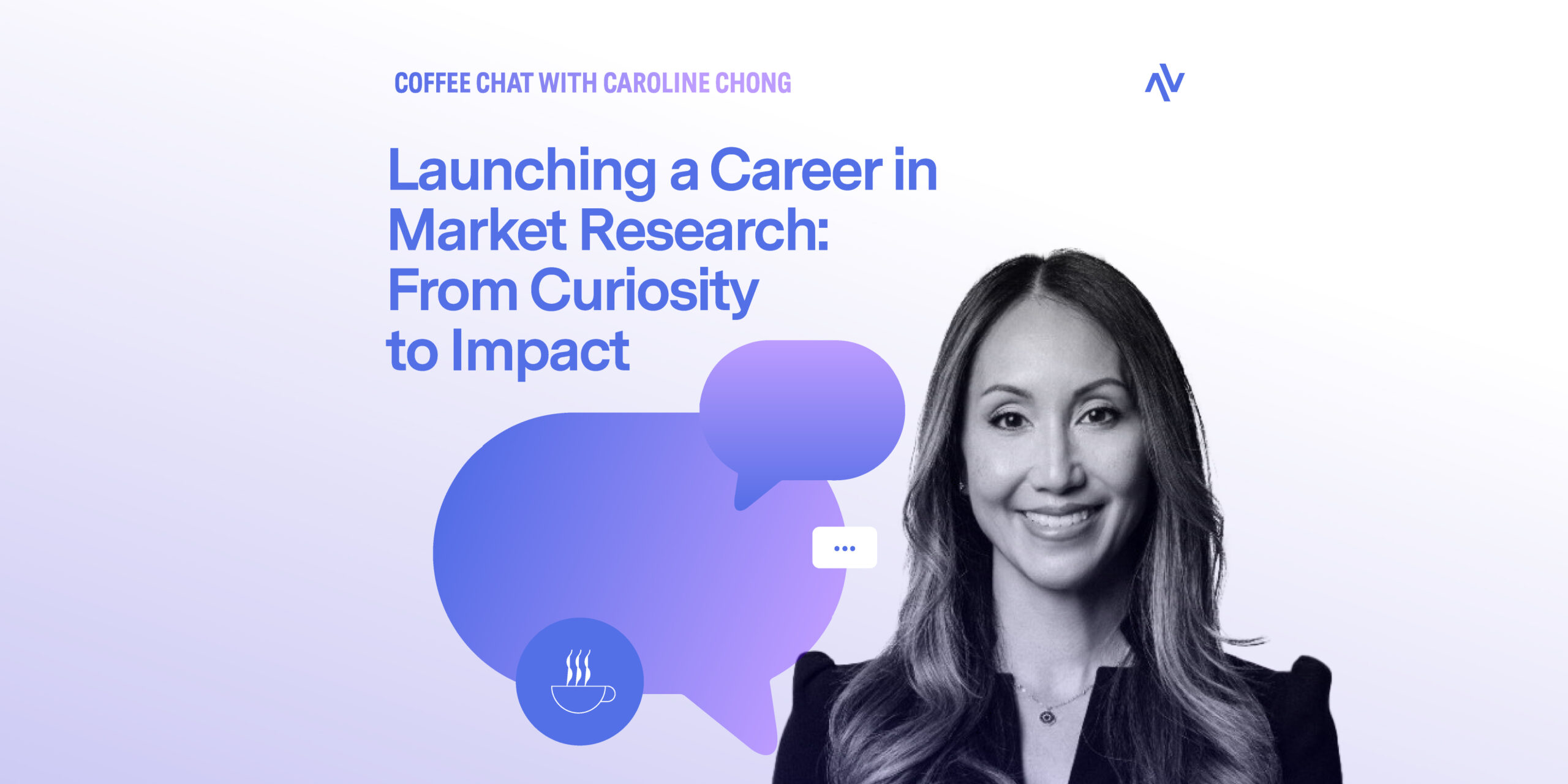
Choosing a career path is rarely a straight line. In this Coffee Chat, we hear from Caroline Chong, a Market Research Fellow whose journey into marketing and research evolved through exploration, curiosity, and a willingness to step outside her comfort zone.
From beginning her career in Sales at Kraft Foods to developing strategic and analytical expertise at Reckitt and later leading full marketing teams, Caroline’s path highlights how hands-on experience shapes clarity over time. What began as exposure to marketing in university gradually developed into a deep appreciation for market research as the backbone of effective strategy. For her, research is not just about collecting data. It is about understanding consumers at a deeper level and translating insights into meaningful business decisions.
In this Coffee Chat, Caroline reflects on building well-rounded skills, connecting insight to impact, leveraging AI responsibly, and cultivating curiosity as a long-term advantage in market research and beyond.
A: I am generally someone that knows what she likes and what she wants, but when I had to choose “what I want to be when I grow up,” I had a very tough time. I had preconceived notions of what certain careers were like and what was involved, like being a doctor, but outside of this, I truly did not have a clue what every career entailed. I felt like I had to decide what I would do for the rest of my life, which seemed like a great deal of pressure. So, I decided to do what I thought I would be best at and enjoy the most, based on some exposure I had in high school, as well as seeing what my dad did for a living. I did my undergraduate degree in Business Administration with a major in Marketing. When I finished my studies, I still was not sure in what industry I wanted to work in, as well as in what capacity, so in a way, I let the universe decide for me.
I stumbled across a job posting for a role in Sales with Kraft Foods. The posting had been written like a recipe, and for some reason it spoke to me. I immediately applied and thought I would give it a try. I was offered the job and started my career challenging the status quo and really going outside of my comfort zone. But in doing so, I got to know my strengths, areas of development and what I enjoy doing.
I continued to challenge myself by moving to a different company, Reckitt, so that I could deepen my knowledge in financials and develop entrepreneurial skills in a results-driven company with a high focus on financial and business acumen. I started in Sales but managed to show my potential and got promoted to a role in Trade Marketing. This was a highly analytical and strategic role where I got more exposed to different types of data and insights and got a chance to really understand how to translate this into strategic recommendations. I began to develop a passion for data and learnings that fast forward years later when I got the opportunity to lead a full marketing team as the Head of Marketing (Reckitt)/ VP Marketing (Coty).
I quickly learnt that product development and ultimately the overall marketing strategy stems from and is dependent on high-quality, robust Market research. It is the backbone of truly understanding the consumer – what they want, what they need, what they are missing, what they are interested in, and how they would behave, purchase intention, perception, etc. I first got a feel for market research in University. I had the opportunity to participate in a class that was entirely self-led, but under the guidance of a marketing professor. I had to develop an end-to-end marketing strategy for a new car launch, including the creation of needed questionnaires, collection of the research itself and then analysis of the data that informed my final direction and recommendation. It was a huge piece of work but so amazing to see market research in action. My first memories start here and the rest is history!
If I can leave readers with 1 key takeaway: it’s good to be a master of your craft but take the opportunity to develop yourself in different ways and to become as well-rounded as possible. The only way to truly know what you like and if you’re good at it, is by doing it. Experiences will enrich your knowledge and add to your perceived value!
A: It is essential that the focus is not on market research alone. The most successful researchers are those that connect the insight with impact, by finding the ‘why’ and the ‘so what’ out of data.
Students will be most successful if they can see the bigger picture. If they understand the overall strategy, context, landscape, and how the marketing research connects to the overarching strategy and objective, they will give people the ability to drive action and decisions from the insights.
The best way to get started now is to get comfortable translating the charts and tables into a summary/insight story. To help you organize the data and your thoughts, it would also be a good idea to get to know visualization software such as Power BI or Tableau.
A: Conducting market research and getting started can be extremely overwhelming. One of the most common challenges is collecting data without a clear business goal or objective. If the ‘problem’ you are trying to solve is not focused, specific and defined at the beginning, it is easy to go down the wrong path. Always start with a clear problem statement such as ‘why do women aged 25-35 prefer Brand X to Brand Y?”
Other hurdles can come if the target audience selected is too broad, or the data collection method is not aligned with the problem statement. Qualitative data is good to understand the why, but quantitative is most effective in the ‘how much’ or ‘how often.’ A mix of both is generally needed to get strong insights. At the end of the day, the quality of the input always determines the quality of the output.
In addition to this, as highlighted in the previous question, it is critical that the findings be translated into something actionable. Think about what the data is telling you and what the corresponding indicated action would be. The process overall is very involved, so it is essential to take everything one step at a time, connecting it back to your problem statement, if ever there is any question. The more practice, the better you will be and the more comfortable you will get!
A: AI should be viewed as a facilitator and a tool to improve the quality of insights. AI is driving efficiency, helping to reduce the amount of time spent on data mining and instead freeing up more time for critical thinking and interpretation of the ‘why.’ It also allows for faster, ad hoc testing.
With AI-powered predictive analytics we can also now move from simply describing to predicting consumer trends, brand health and purchase intent, for example.
In my business, we were trying to understand in what stores our products performed better. Generally, this is a very manual exercise, but to speed things up, we used AI. When grouped an analyzed via AI, we found that stores previously grouped together by geography, actually had more in common with stores with similar consumer purchase behavior. AI enabled us to find patterns and find insights that we historically would not have been able to synthesize on our own.
Human judgment will always be needed. AI can analyze data, but it cannot understand people. As a result, AI will not replace market researchers, but researchers who use AI will replace those that don’t.
A: Always remember that no question is a dumb question. Curiosity is what has enabled us to be where we are today. It has, for example, unlocked medical and technological advancements and social and cultural progress. The best researchers ask questions and challenge the status quo. Stay curious!
Be sure to also network. You are your own best advocate, and relationships you build early often lead to opportunities in the future. Sometimes it’s not about what you know, but who you know and what those people know you know.
The biggest thing that has made an impact on my career has been my openness – willingness to try new things, willingness to learn willingness to experiment. When you say yes (of course with boundaries and within reason) so many doors with so many possibilities unfold before your eyes.
Final Thoughts
Across this Coffee Chat, Caroline emphasizes that success in market research extends far beyond technical skills. Strong market research professionals understand context, connect insights to strategic impact, and translate data into compelling stories that drive action. No matter what you’re doing, clarity of purpose and thoughtful communication make the difference so investing on improving skills connected to this, is vital.
Her advice for students is both practical and empowering: start with a clear problem statement, align your methods to your objective, and always ask what the data means and what should happen next. Embrace AI as a tool that enhances efficiency and pattern recognition but remember that understanding people requires human judgment and empathy.
Above all, stay curious and remain open to new experiences. Careers are rarely predetermined, but through experimentation, learning, and relationship-building, students can gradually shape paths that align with both their strengths and their interests.

Danila Blanco Travnicek is the Director of Program Strategy & Evaluation at The Build Fellowship where she leads the education programming and its initiatives. She is a social entrepreneur who has been working tirelessly for over 10 years in the nonprofit sector to ensure more people have access to quality education. Danila holds a B.A in Business Management and a master's degree in Teaching and Nonprofit Management. She is a Professor at the University of Buenos Aires, an international speaker and facilitator and has managed and led programs with social impact in Latin America, U.S., Europe and Asia. She also received scholarships to study abroad in Finland, China and the United States.

Rik Abels is a Finance Build Fellow at Open Avenues Foundation, where he works with students leading projects in investment analysis and entrepreneurship. Rik is a Principal at Clew Partners, where he focuses on advising buy-side clients on M&A transactions, sourcing and facilitating acquisitions for strategic investors across a number of different industries.
Rik has over three years of experience in the finance field. With a background in technology venture capital, government, and public policy, he has spent the past years advising clients on acquisitions in sectors such as IT services, pharma services, and residential and commercial home services. Rik holds a Bachelor of Arts in Economics and Government from Dartmouth College.


Stay updated on all things Open Avenues!
