
Share:
Share:
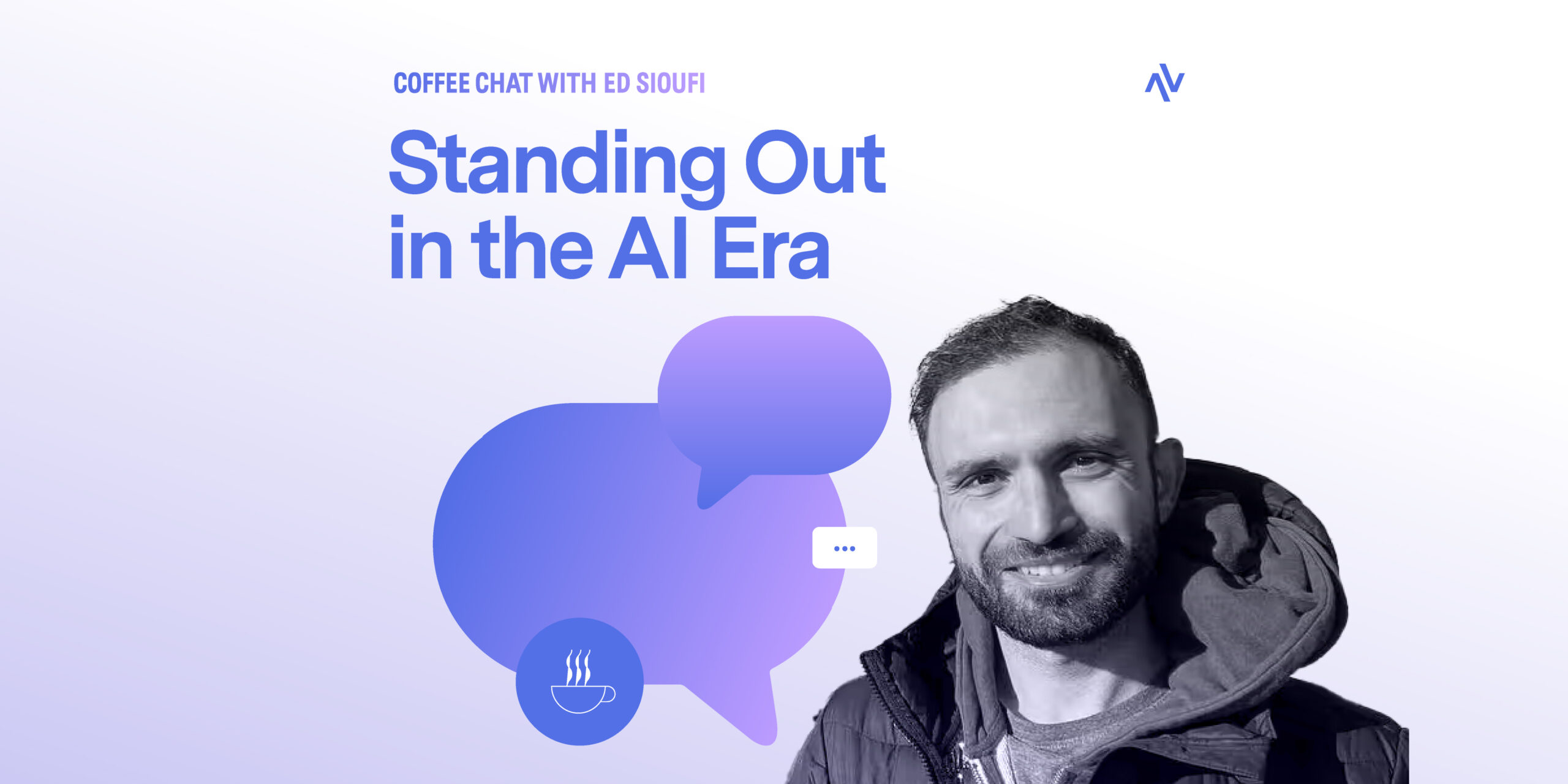
Our coffee chat series is about having the kind of conversations students often wish they could have with someone further along in their career. This edition, we interviewed Ed Sioufi, a Build Fellow at Open Avenues and an experienced software developer.
Ed is a Software Development Build Fellow at Open Avenues, where he works with students leading projects in software development. Ed is also a Staff AI Engineer at Replit, a platform that enables anyone to build applications using natural language.
With over 10 years of experience in software development and product management, Ed has developed a deep expertise in creating scalable, user-centered software solutions. He holds a BS in Computer Engineering and an MS in Management Information Systems from Télécom Paris. His career includes pivotal roles at various early-stage startups, a period of freelancing, and co-founding a professional mentoring startup based in London, where he served as the CTO and drove the company’s technology vision.
Ed’s perspective on software engineering is shaped by curiosity and a forward-looking approach to how AI is changing the field. He sees AI not as a shortcut, but as a thinking partner—one that can accelerate learning, challenge assumptions, and raise the bar for judgment and critical evaluation.
In this conversation, Ed shares insights on the misconceptions around AI, the emerging skills that will define the next generation of developers, and the qualities that make candidates stand out in a competitive job market. A highlight of this chat: his advice on how students can prepare for the rise of AI engineering as a distinct career path.
A: The biggest misconception is that AI is just a code generator.
The better frame is AI as a thinking partner. Use it to sketch architectures, challenge your assumptions, and review your approach. When it does something differently than I would, I ask “why not my way?” Sometimes it has a better reason. Sometimes I do. Either way, I learn.
I use AI to onboard to codebases. I ask it to generate diagrams, explain architecture, and suggest why certain tradeoffs were made. You can point it at well-written open source code and ask, “why this data structure instead of that one?” It accelerates understanding in ways tutorials don’t, because you’re directing the learning at exactly what you don’t understand.
A caveat: AI’s explanations are inferences, not ground truth. It doesn’t actually know why the original authors made their choices. Treat it as a starting point, not the final answer.
The second misconception is that AI lowers the bar. Often it raises it. When everyone has the same tools, the differentiator is judgment. Your ability to verify that what AI produced actually solves the right problem. The goal isn’t generating code faster. It’s developing the critical eye that makes these tools useful.
A: The shift from writing code to verifying it. AI can generate code; that’s not new anymore. What’s emerging is that the ability to evaluate AI output is becoming the core skill. Can you spot when generated code has a security flaw? Can you tell when it’s solving the wrong problem? Verification is becoming as important as production, and most people aren’t training for it. That’s why it’s become as or more important to learn how to read code efficiently. Practice by reviewing open-source PRs before reading what the maintainers said.
AI agents and feedback loops unlocked a new paradigm. AI tools are evolving from autocomplete to autonomous agents that can test their own results and iterate. When AI gained the ability to run code, check the output, and course-correct, that led to a noticeable shift in what’s possible. Understanding how to work with these systems, how to set up guardrails, and when to trust their output is a skill that barely existed a year ago.
Architecture is moving up in importance. As AI handles more implementation, the human value shifts toward the decisions AI can’t make on its own—the big picture. What’s the vision for this system? What constraints come from your company’s culture, your users, your business model? AI doesn’t have that context. It can’t deduce your company’s priorities or the tradeoffs that come from knowing your team’s strengths. Learning to think architecturally, even through small proof-of-concepts, has become invaluable.
The portfolio bar has risen. A project that took a week two years ago can now be built in an hour or two—AI is especially strong at 0-to-1 prototyping. Hiring managers know this. Previous tutorials are now one-shots. So build more. Build useful things. Show you’re adapting to the pace of change, not just completing coursework.
A: Genuine curiosity. That’s what I notice first.
I spent a few hours of my free time using AI to read through the Redis codebase—not because anyone asked me to, but because I was curious about their design decisions. That actually made for interesting conversation during one of my hiring interviews. At any level, showing up with that kind of curiosity about your craft stands out. It tells the interviewer you’re not just checking boxes. You actually care about how things work and why.
The second thing is readiness. The biggest worry hiring managers have about junior candidates is ramp-up time: How long before you can actually contribute. I see this firsthand in my teaching work at Open Avenues. We’ve made tool proficiency part of how we define project levels. Students who show up with their IDE set up, their AI tools configured, and know their way around GitHub have an unfair advantage. They focus on what matters instead of fighting their environment.
Have your AI toolset ready. Know Claude Code, know your IDE, stay current as things evolve. Set up CI/CD on your portfolio projects—GitHub Actions is free. Learn what telemetry means. At a previous data engineering startup, we specifically sought engineers with dbt experience because we didn’t have time to train on the toolchain. That reality applies everywhere: companies want people who can contribute quickly.
A: Don’t just use AI to “improve your resume.” That gives you generic, polished-sounding bullet points that look like everyone else’s. Instead, flip the dynamic.
Tell AI: “You’re the hiring manager at [company] for [this specific role]. You received this resume. What do you think of this candidate? Would you interview them? What questions would you ask?”
Let it evaluate you honestly. Then take those questions to a new chat and work on developing stronger answers. Iterate until you’re satisfied. You’re essentially running a simulation—discovering your gaps and filling them before a real interviewer finds them.
When I did this with my own resume, it didn’t just help me prep for interviews. It gave me a clearer understanding of the cohesive story across my experience, what my actual strengths were, and where I could realistically land next. It’s a self-assessment tool as much as it is interview prep.
Here’s the kicker: whoever is hiring you might put your CV through an AI evaluator or work their hiring decision with an AI assistant. Maybe the same one you used! So you might as well stress-test your application with the same tools they’ll use to judge it.
A: Yes, and to be clear, this isn’t machine learning research. AI engineering is about building products and systems with AI models, not training them from scratch.
What makes AI engineering genuinely different from traditional software engineering is non-determinism. In traditional engineering, you write code and expect the same input to produce the same output. With AI, that guarantee doesn’t exist. The same prompt can give you different results. The same model can behave differently after an update. This is a fundamental shift in how you build, test, and reason about systems.
Here’s what most people don’t talk about: that non-determinism is actually a blocker for many seasoned engineers. If you’ve spent years building deep expertise in systems design or backend engineering, you’ve developed a love for precision and determinism. Dropping that mindset—reinventing how you think about reliability—is harder than it sounds. Many experienced engineers are reluctant to make that leap.
That creates a real opportunity for people entering the field now. Juniors aren’t competing against experts with decades of established patterns—because those patterns don’t exist yet. You have a chance to be “AI native,” to enter without prior assumptions or misconceptions to unlearn.
This is different from ML research, which has clearer academic paths and more established career trajectories. AI engineering requires relentless experimentation—developing an intimate, constantly up-to-date understanding of the latest tools and models. The field is still being figured out, which is both the challenge and the opportunity.
Like any engineering discipline, strong fundamentals are non-negotiable—data structures, algorithms, core computer science. Being AI native is an advantage. Being AI native without fundamentals isn’t.
Final Thoughts
Ed’s insights remind us that thriving in today’s tech world isn’t about relying on AI to do the work for you—it’s about developing the judgment, curiosity, and adaptability to use these tools wisely. He emphasizes that fundamentals still matter, but the differentiator is how you approach learning, verification, and architectural thinking in an AI-driven landscape.
His perspective shows that students and entry-level professionals have a unique opportunity to become “AI native,” embracing experimentation and building portfolios that reflect both technical skill and readiness to contribute. By combining curiosity with preparation, and fundamentals with adaptability, Ed demonstrates how the next generation of developers can not only keep pace with change but help shape it. It’s exciting to see him bring this mindset to his role as a Build Fellow at Open Avenues.

Danila Blanco Travnicek is the Director of Program Strategy & Evaluation at The Build Fellowship where she leads the education programming and its initiatives. She is a social entrepreneur who has been working tirelessly for over 10 years in the nonprofit sector to ensure more people have access to quality education. Danila holds a B.A in Business Management and a master's degree in Teaching and Nonprofit Management. She is a Professor at the University of Buenos Aires, an international speaker and facilitator and has managed and led programs with social impact in Latin America, U.S., Europe and Asia. She also received scholarships to study abroad in Finland, China and the United States.

Mazvita Maboreke is a Human Resources Analyst at Open Avenues Foundation. In her role, she leads initiatives that foster team development, professional growth, and a positive organizational culture. She focuses on designing and implementing programs around training, onboarding, team-building, and employee recognition—helping to cultivate a workplace that is both supportive and high-performing.


Stay updated on all things Open Avenues!
